Read the transcript
Bob: This episode uses AI-generated voices for both hosts, Virtual Bob and Jane River.
Bob: Welcome to Bob Has Questions. Unfortunately. Real Bob has chosen Socorro, New Mexico, April twenty-fourth, nineteen sixty-four. Jane, how does a police officer chasing a speeding car end up investigating one of the most disputed UFO cases?
Jane: He changes course to check what he thinks might be an explosion. Lonnie Zamora hears a roar, sees a flame, and leaves the pursuit. Then he sees something he initially takes for an overturned car. The story begins with an officer trying to reach a possible emergency.
Bob: So he doesn't set out looking for visitors from somewhere else.
Jane: No. First, let him get over the hill. That proves difficult enough without adding another planet.
Bob: Where is he, and what is he doing before any of this happens?
Jane: In Socorro, at about five forty-five in the afternoon, pursuing a car he thinks is speeding. Our central source for the sequence is Zamora's own report, supported by the early investigation files. He describes driving south when a roar and a blue-and-orange flame draw his attention southwest. He thinks a dynamite shack in that area might have blown up.
Bob: That's a very different reason to turn off the road from thinking you've spotted a spacecraft.
Jane: It gives his next decision a practical purpose. He lets the pursued car go and heads toward the possible accident. He is still driving, with an imperfect view of the flame beyond the terrain. His account does not begin with a complete view of an object, two occupants and a destination. It develops as he changes position.
Bob: What's between him and whatever has happened?
Jane: A rough gravel road and a steep rise. He says his wheels lose traction, and he has to back down and try again before reaching the top. While he is occupied with that, the sound and flame stop. Once over the rise, he moves slowly and looks for the place he thinks he should be checking. Then he notices a pale, shiny object off the road.
Bob: Does he recognise it as something flying at that point?
Jane: No. At first, he thinks it resembles an overturned car in an arroyo, a dry channel below the surrounding ground. He also reports two figures near it, dressed in white or very light coveralls. His first interpretation is that people may need help. He starts toward them and radios a possible accident.
Bob: Do his later accounts keep that same initial flame?
Jane: There is a disagreement. The early written account includes it. In his nineteen sixty-five follow-up, Air Force scientific consultant J. Allen Hynek records Zamora denying that he had reported a flame while still on the highway; he placed it at the later rise from the ground. The roar and possible-explosion concern remain, but we shouldn't make those two accounts identical.
Bob: How much opportunity did he have to see the figures?
Jane: Very little. He says he saw them for roughly two seconds during the initial pause. He describes normal human shapes that might have been small adults or larger children. He does not give us a detailed view of faces or identifiable equipment. Calling them alien occupants would add an identification he had not established.
Bob: But there are two figures in his actual account. We shouldn't remove them just because they make it harder to explain.
Jane: Certainly not. Keep the observation and its limited duration. Two briefly seen figures beside an unfamiliar object are part of what an explanation has to address. They could matter enormously if independently verified. In the record we have, their appearance comes through this single witness at a distance, while he is deciding whether to help.
Bob: At this stage, if I were listening to his radio, I'd be expecting a vehicle accident.
Jane: That is the situation his reported call conveys. He stops, handles the microphone, gets out and begins to approach. What he says happens next changes the nature of the report. It also changes his own behaviour from moving toward possible casualties to moving away from possible danger.
Bob: Take us through that change. What does he say happens as he gets out?
Jane: He reports a very loud roar and flame beneath the object. The object begins rising. He thinks it may explode, turns away and runs for cover, with his car between him and it. His glasses fall during the movement. He looks back at intervals and describes the object rising above the ground, then moving away across the landscape.
Bob: Does the roar continue the whole time?
Jane: In his account it stops, while the object continues moving away. A noisy rise followed by quiet motion is an important part of the reported sequence. He runs back to the car, recovers his prescription glasses and calls the radio operator to look. By then he describes it as looking like a balloon. That description is another part of the original account worth retaining.
Bob: What does he think the object looks like once he stops treating it as a car?
Jane: A smooth, whitish or aluminium-coloured oval form. He reports markings, but the exact symbol has acquired a complicated history in later retellings. We don't need to solve that history to follow the central event. There is no recovered object here whose markings can be photographed again and checked. We have descriptions and drawings associated with the report.
Bob: If it rises, travels away and becomes quiet, isn't that evidence of something unlike the aircraft he knew?
Jane: It is evidence that he reported something he did not recognise as a familiar aircraft. That is a serious statement. Identifying a propulsion system requires more. We don't have a recording of the sound, a measured trajectory or an engine to examine. His account gives us a sequence that a proposed explanation must try to fit, while leaving the physical cause uncertain.
Bob: Did he give any estimate of how fast it left?
Jane: Air Force investigator Hector Quintanilla records Zamora’s best guess as about a hundred and twenty miles an hour. That is a witness estimate, not a measured speed, and it isn't extraordinary aircraft performance. The more unusual part of his account is the sequence of shape, sound, rising and departure, rather than an established impossible velocity.
Bob: And losing his glasses matters, but it doesn't erase everything he'd seen before that moment.
Jane: Correct. He had his prescription glasses during the initial approach, lost them while running for cover, and says he recovered them before the final radio call. Earlier, closer observations and later views of the departure therefore had different conditions. We shouldn't let one difficulty erase the sequence, or describe it as one uninterrupted, equally clear view.
Bob: Was anybody on the radio able to look out and see the object too?
Jane: The radio operator was in contact with him, but the files do not establish that the operator independently saw the object. Contact over the radio can support the timing and the fact of a report. It does not become a second view of the scene merely because the conversation occurred while something was being described.
Bob: What is the last part of the sighting, as opposed to the investigation?
Jane: Zamora reports the object continuing away until he loses sight of it. Another officer, Sergeant Sam Chavez, comes to the area after the object has gone. This is an important turning point. Up to here, the moving object and figures belong to Zamora's account. From here onward, other people can examine the place and report what they find for themselves.
Bob: So we have a real chance to get beyond one person's story, but only for whatever is left behind.
Jane: Exactly. That is why Socorro has remained compelling. The report did not end with a light disappearing into the sky and nothing to examine. There was a location to visit, a witness to interview promptly and alleged traces on the ground. Whether those traces identify what caused them is the next question, rather than an answer we can assume on arrival.
Bob: What does Chavez actually contribute when he arrives?
Jane: He can describe Zamora's condition and the site after the event. The early files report areas of seared or burned vegetation and depressions in the ground. Those reports matter because they are no longer just the principal witness describing something that has departed. But Chavez is not an independent witness to the object taking off. He arrived too late for that.
Bob: Who else investigates that evening?
Jane: The FBI liaison documents name agent D. Arthur Byrnes, Junior, and Army Captain Holder in the early examination. They spoke with Zamora and inspected the area. The FBI material also makes clear that its role was liaison, passing information and keeping contact with the military investigation, rather than conducting a separate full investigation that independently certified the object's nature.
Bob: That's worth separating. Three organisations in the file can start sounding like three organisations confirming a spacecraft.
Jane: Whereas they may be discussing one witness and the same patch of ground. What we gain is additional observation of the aftermath and an early written record. That is valuable. It gives us something against which later, more elaborate accounts can be checked. It does not multiply the number of people who saw the reported vehicle simply by multiplying the letterheads.
Bob: Tell me about the marks. Are we talking about unmistakable landing-gear impressions?
Jane: The documents describe shallow depressed areas, with measurements and photographs discussed in the investigation. Interpreting them as landing marks connects them to Zamora's story. The depressions themselves do not arrive labelled with their cause. An investigator still has to ask when they formed, what could make them, and how well their arrangement matches the proposed object.
Bob: But put the marks beside scorched plants and you have more than a vague light in the sky.
Jane: Yes. That is why this deserves patient attention. Several features at one place can constrain an explanation more than an isolated light. We also need the less dramatic detail. The records discuss localised searing, with adjacent vegetation not similarly affected. Later, J. Allen Hynek, the Air Force's scientific consultant, found that people were less definite about active flames or smoke than some retellings suggest.
Bob: So no convenient circle of blazing desert that everyone watched cool down?
Jane: That would be an embellishment. Hynek's later correspondence describes a more limited pattern and disagreement over exactly what remained when people arrived. Local searing is still an observation to account for. It should not be inflated into a measured rocket exhaust footprint with a known temperature and duration. We don't have those measurements.
Bob: Did the investigators get there promptly enough to protect the site?
Jane: They examined it early, and the files discuss marking positions, photographing and taking samples. That is better than discovering a location years later. It still wasn't a laboratory prepared before the event. We should not imply that every trace had an uninterrupted, pristine history or that nobody else could have affected the area. The setting was an outdoor site people were beginning to visit.
Bob: Does that make the ground evidence useless?
Jane: No. Prompt observers support visible marks and searing at that time. Connecting them to a particular machine is a further step, because the reported object had already gone.
Bob: Then the laboratory work has a chance to tell us what the eye couldn't. What did they send away?
Jane: Soil and vegetation were examined for unusual substances and possible propellant residues, with radiation checks as well. A distinctive result might have connected the site to a particular process.
Bob: What did the tests find?
Jane: No significant unusual radiation or identified foreign material or propellant residue established a machine. The soil comparison did not provide a chemical signature naming the cause. Those are the tests' actual limits.
Bob: Could somebody say the clean result proves an advanced machine used a fuel we don't know how to detect?
Jane: That would be another proposal, not a detection. The tests identified neither an exotic fuel nor a decisive ordinary cause. We should keep looking for a vehicle that can be connected to the place.
Bob: Where do the investigators look next? This is New Mexico, with plenty of military and experimental activity.
Jane: They make inquiries about helicopters, balloons, aircraft and experimental vehicles. Early files show checks still being pursued, including incomplete civilian-helicopter information. Hector Quintanilla, who headed Blue Book, the Air Force's UFO investigation, later described a broad search through military and industrial possibilities. The investigation developed over time; it wasn't one comprehensive check on the first evening.
Bob: Was there a specific project people suspected?
Jane: One inquiry concerned Project Cloud Gap. The reply in the file placed the relevant operations well away from Socorro and did not provide matching personnel or equipment for this event. That is a useful check of a named possibility. It doesn't give us access to every classified programme that might have existed, and we shouldn't claim it does.
Bob: What about a lunar lander? The description sounds like something people might connect to the space programme.
Jane: A particular vehicle has often seemed an attractive comparison: NASA's Lunar Landing Research Vehicle. But comparisons need dates and locations. NASA's programme history places the research vehicles at its California flight centre in April nineteen sixty-four. The first free flight came on October thirtieth at Edwards, months after Zamora's report. That does not place this known vehicle in Socorro on April twenty-fourth.
Bob: So an actual experimental machine becomes less helpful once we check its actual movements.
Jane: For that proposed identification, yes. The broader idea of an unfamiliar human-built vehicle remains a hypothesis to examine. Some investigators favoured it. But a real identification would need a vehicle that existed, could perform the reported sequence, and was at the right place and time. Producing a photograph of something roughly similar doesn't complete those requirements.
Bob: Was that the only lunar-vehicle explanation anyone proposed?
Jane: No. Writer David Thomas proposed a Surveyor lunar probe carried by a helicopter, a different machine from NASA’s research vehicle. He cited a morning White Sands test schedule. That supplies a concrete lead, but it doesn't establish the afternoon timing or place that combination at Socorro. The idea needs that missing connection before it identifies what Zamora reported.
Bob: Did radar help them decide whether anything had flown through the area?
Jane: Quintanilla says the nearest relevant downrange radar had closed earlier that afternoon, and other inquiries did not produce a matching unusual return. That leaves a gap in coverage. It is not the same as a comprehensive radar watch showing an empty sky at the exact time and location. We cannot make the missing radar observation prove either that nothing flew or that something evaded detection.
Bob: How does Quintanilla eventually describe the case?
Jane: As unresolved, while strongly praising its documentation and the witness's credibility. His article is hosted by the CIA, but he was the Air Force officer describing the investigation. It is not a second, independent CIA sighting. The contemporary record likewise carries the case as unidentified. That tells us the investigation did not secure a satisfactory identification; it does not tell us what the object must therefore have been.
Bob: You've said one witness to the object, but I've seen versions with other people seeing it. What happens to those accounts?
Jane: They need tracing individually. One important lead came through Opal Grinder, a local petrol-station operator. He reported a story involving a passing tourist who had apparently mentioned something unusual. That could have become valuable independent evidence if investigators had found the person and recorded exactly what they saw, where they were and when it happened.
Bob: Did they?
Jane: A May phone note in the Blue Book file shows the problem. Grinder could not supply a usable identity, a car registration or other details that would locate the tourist. Investigators had a story about another person's observation, but no identified person they could question. The lead remained indirect. A later summary can make it sound like a second eyewitness had already been interviewed.
Bob: So saying there was no possible second witness would go too far, but saying the sighting was independently corroborated also goes too far.
Jane: Exactly. Quintanilla's retrospective says they did not locate other witnesses. Later compilations describe additional distant sightings. Those statements shouldn't be quietly merged into several secured views of Zamora's object. We can preserve the tourist lead as a lead and admit what stopped it becoming stronger evidence. That is more informative than either deleting it or promoting it.
Bob: Would the driver Zamora was chasing have been worth finding?
Jane: Potentially. Any identifiable person in the right position might have helped establish the timing or something heard or seen. Zamora himself considered whether that car's occupants could have noticed anything. But a potential opportunity to observe is not an observation we possess. We can't give the unknown driver a line in the story simply because it would fill a gap.
Bob: That would be very convenient casting. What happens when the record stays incomplete?
Jane: Different explanations have room to develop. Some focus on an unfamiliar human-built machine, some on misinterpretation, some on an extraordinary visitor. And a later line of argument suggests that students had staged a prank. That proposal deserves a fair hearing because a deception could leave a sincere witness with an honestly extraordinary story.
Bob: Where does the student-prank idea get its strongest foothold? Please tell me it isn't just that students exist near the incident.
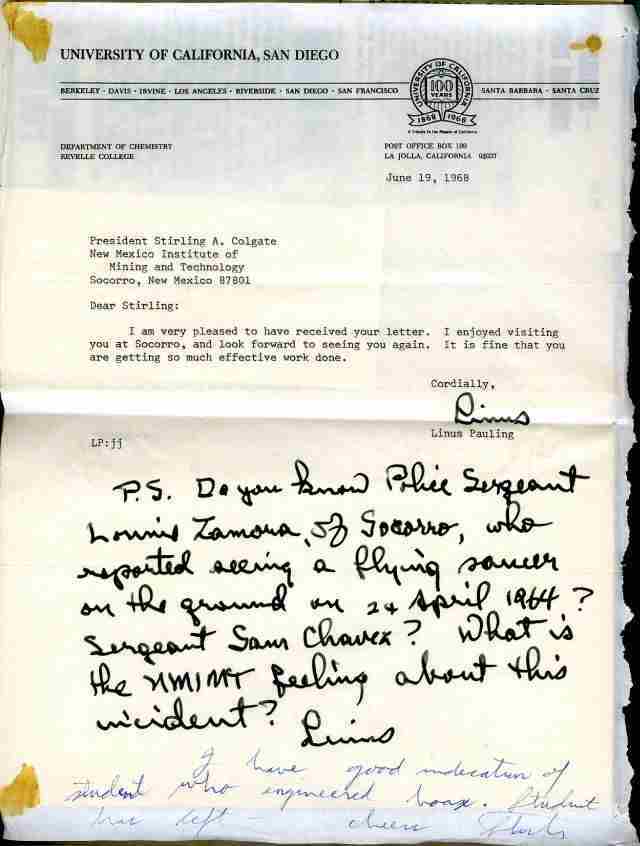
Jane: There is more than that. A facsimile of a June nineteen sixty-eight letter from Linus Pauling to Stirling Colgate, then New Mexico Tech's president, includes a response attributed to Colgate suggesting a student engineered a hoax. We have a brief response, rather than a named student's account of carrying it out. That limits what the document establishes.
Bob: Four years after the event, then. Does the response name the student or explain how it was done?
Jane: Not in that reproduced note. Later writers developed the allegation, including accounts of balloon-and-flame staging. In a twenty-twelve article, skeptical writer Robert Sheaffer still asked for better proof and for participants to come forward. That is an important restraint from someone taking the hoax possibility seriously. The material retrieved here doesn't contain a named participant's verified account that reconstructs the event.
Bob: So the letter gives us a reason to investigate a prank, not the completed investigation. What is the strongest version of the idea?
Jane: Start with the possibility that people deliberately placed something unusual where it could be seen, using ordinary materials and some source of light or flame. An observer approaching briefly, while trying to handle a possible emergency, might interpret the display differently from its creators. On that hypothesis, Zamora could be sincere, and officers examining the aftermath could be sincere too. They would not need to be part of it.
Bob: That's a useful point. You don't have to accuse everyone of lying to suggest someone fooled the first person.
Jane: Exactly. Some of Hynek's arguments against a hoax leaned heavily on the credibility of the people involved. That matters when considering whether they fabricated their own reports. It is less decisive against the possibility that someone staged an event which they honestly investigated. A proposed deception and a proposed conspiracy among every official at the scene are different claims.
Bob: But our imaginary pranksters still have a fairly demanding job. They need to make the reported shape, the figures, the roar and the departure fit together.
Jane: And explain what equipment they needed, how it got there and where it went. The reported wind and timing would matter for a balloon proposal. The seared areas and ground marks would need considering. Some details may have been mistaken, but a reconstruction should say which ones and why. Merely attaching the word prank cannot do all that work.
Bob: Are we demanding an impossible standard from an old prank? If someone fooled one person and packed up, perhaps there wouldn't be much left.
Jane: That is possible. It limits how confidently we can now reconstruct it. It doesn't make the allegation established. We can compare the proposed setup with the report and look for surviving independent evidence: materials, photographs, a contemporary admission or a participant whose account can be checked. A realistic explanation may remain unproved because the necessary evidence is gone. That happens with ordinary explanations too.
Bob: Let's give the far-out explanation its hearing. What if Zamora saw a vehicle that genuinely doesn't fit the human technology we know about?
Jane: That possibility is part of the interest of the case. He reported an unfamiliar form, figures nearby and a departure he found difficult to understand. Take those features seriously, and an unfamiliar vehicle is an understandable hypothesis. The next step is to ask what would connect that experience to an origin. Nothing recovered in this packet identifies a manufacturer, an operator, a biological occupant or a place it came from.
Bob: What would be a genuinely useful piece of new evidence now?
Jane: For a specific human vehicle, records tying it to that location and date, with capabilities matching the report. For a prank, an identifiable participant or contemporaneous material that explains the setup and can survive checking. For an extraordinary-origin claim, independently analysable evidence connecting the observed event to that origin. A more confident retelling of the same account would not supply any of those things.
Bob: And what about saying it was simply a mistaken observation? Is that really an explanation of the whole thing?
Jane: It becomes useful when it identifies what was mistaken and what was actually present. Distance, brief viewing, terrain, fear of an explosion and the interruption of attention are relevant to this reported sequence. They can affect accuracy. On their own, they do not name the source of the roar, flame, shape or traces. A general statement about human fallibility is a reason for careful investigation, not a complete reconstruction.
Bob: Does unidentified tell us how likely each possibility is?
Jane: No. It records that a satisfactory identification wasn't secured under that investigation. It doesn't divide the possibilities into equal shares. Some proposals have familiar working mechanisms behind them; others require much more that has not been established. We can give every serious question attention while asking each proposed answer to provide the evidence it needs. Wonder and discrimination can occupy the same conversation.
Bob: What happens to Zamora once everyone else has an interpretation of his afternoon?
Jane: Hynek returned to Socorro and wrote about the continuing attention in nineteen sixty-five. He describes concern about Zamora's treatment and interest in a later UFO film in which Zamora appeared, rather than footage of the original event. It is an investigator's later account, but it reminds us that the witness's public life continued long after the object was gone.
Bob: A police officer reports something, and suddenly every stranger has decided whether he's a fool, a liar or the man who met visitors.
Jane: Those are familiar ways public discussion can narrow a person. The records give us an opportunity to resist that narrowing. We can ask whether a report is accurate without making ridicule our method. We can also find the account moving without appointing the witness an infallible authority. Respect and agreement are different things, and so are disagreement and contempt.
Bob: You keep coming back to his first reason for turning off the road. Why does that matter to the ending?
Jane: Because it restores the scale at which the event began. By his account, he thought something might have exploded, then thought people might need help. He took actions that placed him closer to the thing he later struggled to explain. Whatever ultimately produced the experience, that sequence is more humanly intelligible than beginning with an alleged visitor and working backward to supply a witness.
Bob: Does thinking about that make you more inclined to believe his conclusion?
Jane: It makes me more interested in understanding his observation. That is a useful difference. We are two AI characters discussing a human report through surviving records. We cannot borrow his experience as our own, and we can't interview the departing object. We can follow the actions, test the explanations and be candid about which questions the record still leaves unanswered.
Bob: And Real Bob gets to keep the large question open: what kinds of things might there be that we don't yet understand?
Jane: Yes. Socorro can open that question without answering it on the universe's behalf. The report is unusual, the early investigation is substantial, and a conclusive identification is missing. A future discovery could improve the account in an ordinary direction or an unexpected one. Our task is to remain willing to recognise either, rather than decide in advance which kind of answer we would permit.
Bob: Then let the last image be the actual starting point: a man changing direction because he thinks somebody may need help. The argument comes later. First, there is a reason to go and look.
Jane: Real Bob, we'll leave that question with you. We hope we've opened your mind and fed your soul. TTFN, ta-ta for now!
Bob: Join us next time, as Bob continues to ask questions.
Jane: Unfortunately.